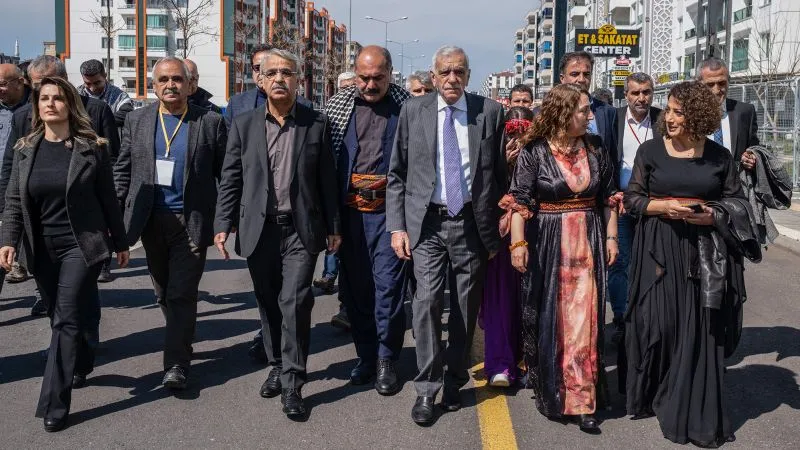
Turkey's Kurdish kingmaker, the pro-Kurdish Peoples’ Democratic Party (HDP), has emerged as a decisive force in the country's upcoming presidential elections. By announcing it will not field its own candidate for the May 14 polls, the HDP has created a strategic opening that may allow opposition leader Kemal Kilicdaroglu to challenge long-time President Recep Tayyip Erdogan. This move follows years of intense government crackdowns on Kurdish political representation. This article examines the HDP's strategic pivot, the legal threats facing the party, and the broader implications for Turkey's democratic future.
How does the HDP act as a kingmaker in the Turkish elections?
The HDP's decision to abstain from fielding a presidential candidate serves as a strategic mechanism that could shift the balance of power toward the opposition. By not running a candidate, the party effectively directs its significant voter base toward a single alternative, potentially preventing a fragmented vote that would benefit the incumbent.
The party's influence is rooted in its ability to mobilize the Kurdish population, which constitutes between 15% and 20% of Turkey's total population according to Minority Rights Group International. While some conservative Kurdish voters traditionally support Erdogan's AK Party, the HDP captures a critical segment of the electorate that remains dissatisfied with the current administration.
The political weight of the HDP was historically demonstrated in the June 2015 general elections. In that cycle, the party secured 13% of the seats, a result that prevented the AK Party from obtaining a parliamentary majority for the first time since 2002. Although a subsequent snap election saw HDP support dip to 10.7%, the party's capacity to deny a single-party majority remains a central factor in Turkish electoral mathematics.
The mathematical impact of Kurdish votes
Political science professor Murat Somer of Koc University notes that the HDP's role is vital because the party commands approximately half of the Kurdish vote in Turkey. This concentration of support means that any shift in how these voters approach the ballot box can fundamentally alter the outcome of a runoff election. If the HDP's supporters coalesce around a single opposition figure, the mathematical path for the incumbent becomes significantly more narrow.
What is the impact of the HDP's decision on Kemal Kilicdaroglu?
The HDP's strategic pivot provides a significant advantage to Kemal Kilicdaroglu, the leader of the Republican People’s Party (CHP) and the primary challenger to Erdogan. The decision to refrain from running a candidate followed a high-profile visit by Kilicdaroglu to the HDP's co-chairs, signaling a potential alignment of interests between the main opposition bloc and Kurdish representatives.
Kilicdaroglu has actively sought to broaden his appeal by addressing long-standing grievances. During his discussions with HDP leadership, he stated that the solution to Turkey's complex challenges, including the Kurdish question, must be addressed within the framework of parliament. This stance distinguishes him from the more nationalist rhetoric often employed by other political factions.
However, the relationship remains complex. While the HDP has not formally endorsed Kilicdaroglu, the deliberate distance maintained by the party may serve a dual purpose. It allows Kurdish voters to support the opposition without forcing the CHP to navigate the immediate political fallout of a formal alliance, which could trigger nationalist backlash.
Why is the HDP facing significant legal and political risks?
The HDP operates under a cloud of legal uncertainty, facing a potential ban from Turkey's Constitutional Court over allegations of ties to the Kurdistan Workers’ Party (PKK). Because the PKK is designated as a terrorist organization by Turkey, the United States, and the European Union, these accusations place the party's very existence at stake.
To mitigate the risk of being barred from the ballot, HDP candidates currently run under the banner of the Green Left Party in parliament. This legal maneuvering is a survival tactic intended to maintain a presence in the legislative process while the court deliberates on the party's future. The threat of closure is not merely a legal formality but a constant pressure that shapes their electoral strategy.
The crackdown on the party has intensified over the last decade. Once, President Erdogan maintained cordial relations with the HDP during a brief peace process with the PKK, even granting certain linguistic rights to the Kurdish minority. However, those ties dissolved, replaced by a period of intense state pressure and the imprisonment of influential figures, including former HDP leader Selahattin Demirtas, who has been detained for nearly seven years.
The danger of political contamination
HDP Deputy Co-Chair Hisyar Ozsoy has emphasized the need for the party to navigate the election with extreme caution. The party seeks to avoid a "contaminated political climate" where the discourse is dominated by ultra-nationalist rhetoric. There is a persistent risk that if the opposition is perceived as being too closely aligned with the HDP, the AK Party will use its media influence to label the entire opposition bloc as being pro-PKK, thereby alienating nationalist voters.
What are the broader implications for Turkey's minorities?
The outcome of the election and the HDP's strategic choices carry implications that extend far beyond the immediate presidential contest. For the Kurdish community, the election represents a struggle for political survival and the hope for a more inclusive democratic framework.
Asli Aydintasbas, a visiting fellow at the Brookings Institution, suggests that a transition in power might provide much-needed breathing space for Kurdish-dominated parties. She notes that a significant number of Kurdish voters have already begun to distance themselves from the Erdogan administration. For the HDP, the current political maneuvering is viewed not just as an ideological struggle, but as a fundamental necessity for their continued existence.
The HDP's leadership maintains that their actions are intended to protect the rights of all minorities in Turkey. By positioning themselves as a kingmaker, they are attempting to leverage their electoral importance to ensure that the post-election political landscape remains open to diverse voices and democratic resolutions to long-standing conflicts.
FAQ: Turkey's Kurdish political landscape
What is the HDP's role in the upcoming election?
The HDP acts as a kingmaker because its decision not to run a presidential candidate allows its voters to consolidate behind a single opposition challenger. This prevents the division of the anti-Erdogan vote, which is crucial for changing the leadership in a runoff scenario.
Why is the HDP facing a potential ban?
The party is currently facing a case in the Turkish Constitutional Court due to suspected links to the PKK, which is classified as a terrorist group by Turkey and the EU. This legal pressure forces the party to run candidates under different names to ensure electoral participation.
How many Kurds live in Turkey?
According to Minority Rights Group International, Kurds represent the largest minority in Turkey, making up an estimated 15% to 20% of the country's total population. Their voting patterns are a decisive factor in national elections.
What was the HDP's impact in 2015?
In the June 2015 general elections, the HDP won 13% of the seats. This result was significant because it prevented the ruling AK Party from securing a parliamentary majority, fundamentally altering the political landscape of the country at that time.
How has Erdogan's relationship with Kurds changed?
Relations have shifted from early cooperation and the granting of certain rights during a peace process to a period of intense crackdown. The current administration has focused on suppressing the HDP and linking Kurdish political movements to militant groups like the PKK.
Key takeaways
- The HDP's decision not to field a presidential candidate empowers the main opposition candidate.
- Kurds constitute approximately 15% to 20% of Turkey's population, according to Minority Rights Group International.
- The HDP faces a potential ban by the Constitutional Court over alleged PKK ties.
- In 2015, the HDP's 13% seat share denied the AK Party a parliamentary majority.
- The party's survival is tied to its ability to navigate nationalist political discourse.
Conclusion
The HDP's strategic pivot from a direct presidential contender to a kingmaker represents a high-stakes gamble for Turkey's political future. By choosing to influence the election through voter mobilization rather than individual candidacy, the party seeks to maximize its impact while minimizing the risk of immediate legal dissolution. Whether this maneuver successfully unseats the long-standing Erdogan administration or triggers a nationalist backlash remains the central question of the 2023 elections. Ultimately, the outcome will signal the direction of Turkish democracy and the degree of political space available to the country's significant Kurdish minority.