The Nasa lunabotics competition is a premier international event where university teams design and operate robots for lunar exploration. A team of 10 students from Queen's University Belfast (QUB) will represent Europe at the University of Central Florida later this month. After winning a previous competition in Milton Keynes, the QUB team will face elite university squads from the United States, Australia, and India. This article explores the technical design of their 52kg aluminium rover, the autonomous capabilities required for lunar simulation, and the broader implications for future human habitats on the Moon.
What is the Nasa lunabotics competition?
The Nasa lunabotics competition is a high-level university challenge designed to test the application of NASA's systems engineering processes in a lunar context. Participants are tasked with designing, constructing, and operating sophisticated robots capable of performing critical tasks on the Moon's surface. The competition serves as a platform to showcase international engineering talent by bringing together the winners of various precursor competitions held across different countries.
At the heart of the competition is the simulation of real-world lunar challenges. Teams must ensure their machines can navigate complex terrains, manage obstacles, and perform specific mechanical duties. According to the QUB team, the event brings together the 'top tier' of global talent, making it a significant milestone for any engineering department. For the students from Queen's University Belfast, this represents an opportunity to demonstrate the practical application of their academic learning on a global stage.
The role of systems engineering in space robotics
To succeed, teams must follow a rigorous engineering lifecycle. This involves not just building a machine, but ensuring every component—from the software code to the mechanical joints—works in harmony under simulated lunar conditions. The competition mimics the high stakes of actual space missions, where failure is not an option and autonomous reliability is paramount.
How does the QUB lunar rover function?
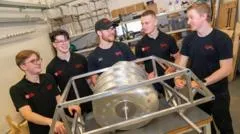
The QUB rover is a 52kg aluminium-framed robot designed to navigate a lunar-simulated environment autonomously. The primary objective of the machine is to enter a controlled room, determine its precise location within that space, and travel to a designated excavation point. Once there, the rover must use its mechanical systems to collect lunar-simulant sand and transport it to a secondary location.
The mission is not merely about moving sand; it is about simulating the foundational tasks required for future human habitation. By moving material to form walls or structures, the robot demonstrates how autonomous machines could prepare the lunar surface for human arrival. This capability is essential for reducing the risk and cost of long-term space exploration, as robots can perform heavy labor before astronauts arrive.
Technical breakdown of the rover's mission
The rover's operational cycle consists of several distinct phases: localization, navigation, excavation, and deposition. The machine must 'figure out' where it is without human intervention, navigate to the sand, and then execute a precise mechanical movement to pick up and drop the material. This requires a seamless integration of sensors, motors, and intelligent software.
What technical disciplines are required to build the robot?
Developing a lunar-ready robot requires a multidisciplinary approach, which the QUB team addressed by dividing their 10 members into three specialized groups: software, electronics, and mechanical engineering. This structure allows for deep specialization while ensuring that the different subsystems can eventually be integrated into a single, cohesive unit.
The software team, led by third-year student Jamie Smith, focuses on the transition from manual control to full autonomy. Before the physical rover was even ready, the team had to develop complex rover simulations to test their code in a virtual environment. This ensures that when the 52kg machine is deployed, the software is already proven to handle the logic of navigation and excavation. Meanwhile, the mechanical team ensures the physical integrity of the machine.
The mechanical and electronic requirements
Mechanical engineering students, such as PhD candidate Jack Fitzpatrick, focus on the physical durability and traction of the rover. The robot must be 'physically strong enough' to survive the stresses of movement and 'well built enough' to withstand a harsh environment. Traction is a critical factor, as the robot must be able to drive over obstacles and through lunar-simulant sand without getting stuck or losing stability.
Why is the QUB team's participation significant?
The participation of the Queen's University Belfast team is significant because they are the only European team participating in this specific Nasa lunabotics competition. By representing the UK and Europe in Florida, the students are not just competing for a trophy, but are acting as ambassadors for European engineering excellence in the space sector. This provides a unique platform to showcase the calibre of research and development happening within the School of Mechanical and Aerospace Engineering at QUB.
While the team acknowledges the high level of competition from the US, India, and Australia, they view the event as a foundational step. Even if they do not secure a win this year, the experience provides a 'base' for future iterations. The goal is to use the lessons learned from this international encounter to refine their designs and return in subsequent years with even more advanced technology.
The impact on future engineering careers
For the students involved, the competition is a 'real opportunity to demonstrate everything [they have] learned.' Such high-pressure, practical applications are invaluable for transitioning from academia to professional aerospace and robotics industries. The hundreds of hours invested in making the rover 'mission ready' serve as a rigorous training ground for the next generation of space engineers.
Frequently asked questions
What is the main goal of the Nasa lunabotics competition?
The main goal is to challenge university students to design and operate autonomous robots capable of performing lunar tasks. These tasks include navigating terrain, excavating lunar-simulant material, and depositing it to simulate the construction of human habitats on the Moon.
How much does the QUB lunar rover weigh?
The robot designed by the Queen's University Belfast team features a 52kg aluminium frame. This weight and material choice are part of the mechanical engineering effort to ensure the rover is both durable and capable of maintaining traction during the competition.
Which countries are competing in the event?
The competition at the University of Central Florida includes highly skilled university teams from the United States, Australia, India, and the United Kingdom. The QUB team is notable for being the sole European representative in this specific competition.
How did the QUB team qualify for the NASA event?
The team earned their place in the international competition by winning a precursor competition held in Milton Keynes. This victory allowed them to advance from the UK-level competition to the global stage hosted by NASA in Florida.
What role does software play in the robot's mission?
Software is responsible for the robot's autonomy. The software team develops the logic that allows the rover to identify its location, navigate to an excavation site, and operate its mechanical tools without direct human control, often using simulations for testing.
Key takeaways
- The QUB robotics team is the only European representative at the Nasa lunabotics competition in Florida.
- The robot is a 52kg aluminium-framed rover designed for autonomous lunar simulation tasks.
- Core tasks include navigating obstacles, excavating lunar-simulant sand, and depositing it to build structures.
- The team consists of 10 students divided into software, electronics, and mechanical engineering groups.
Conclusion
The journey of the Queen's University Belfast students to the Nasa lunabotics competition represents a significant intersection of academic excellence and practical space exploration. By tackling the complex challenges of autonomous lunar excavation and navigation, the team is contributing to the essential research needed for future human Moon missions. Their presence in Florida as the sole European team highlights the growing importance of international collaboration in space robotics. Ultimately, this competition serves as both a rigorous test of engineering skill and a stepping stone for the future of lunar habitation technology.