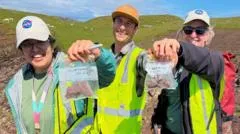
The Nasa search for life on Mars has moved from the Red Planet to the rugged landscapes of the Scottish Highlands. Scientists are currently analysing rock samples from the Stoer Formation near Clachtoll to better understand potential biosignatures. This research follows the Perseverance rover's discovery of markings that may indicate ancient microbial life. By studying Earth's extreme geological environments, researchers aim to refine how they detect and preserve evidence of habitability on Mars. This article explores the geological links between Scotland and Mars, the specific mission objectives, and the historical connection between these two worlds.
Why are Nasa scientists studying rocks in the Scottish Highlands?
Nasa scientists are conducting field research in the Scottish Highlands to bridge the gap between Earth's geological history and the potential for life on Mars. The primary objective is to understand how signs of ancient life are preserved in specific rock types, which can then serve as a blueprint for interpreting data collected by rovers on Mars.
Last year, the Perseverance rover identified potential biosignatures—specific markings on Martian rocks that may have been created by ancient microbes. To validate these findings, researchers need to observe how similar biological markers manifest in terrestrial environments. The Stoer Formation, located near Clachtoll in Assynt, provides a unique laboratory for this purpose. This geological feature contains rocks that formed in environments remarkably similar to the ancient lakes and rivers once present on the Martian surface.
The research expedition is led by the Nasa Goddard Instrument Field Team, a group that specialises in investigating Earth's most extreme environments. By studying how clay minerals and layered sediments interact with biological traces, the team can improve the accuracy of future Martian missions. This work is not merely theoretical; it is a practical application of geological comparison to ensure that when a rover finds a potential sign of life, scientists can confidently distinguish between biological and non-biological origins.
What is the significance of the Stoer Formation for Mars research?
The Stoer Formation offers a geological analogue that mimics the ancient Martian landscape, particularly regarding the presence of water and sediment deposition. While Mars is currently a dry and desolate planet, its history is defined by the movement of water, much like the history of the Scottish Highlands.
According to Nasa, both the Scottish cliffs and the Martian landscape feature layered areas of mudstones and siltstones that are rich in clay minerals. These specific types of sedimentary rocks are crucial because they are excellent at preserving organic matter and microscopic structures over billions of years. The Stoer Formation, specifically around the Clachtoll area, contains evidence of microbial life dating back approximately 1.2 billion years, making it an ideal proxy for studying the potential for life in ancient Martian water systems.
Comparing Earth and Mars geological structures
The comparison between the two planets rests on several key geological pillars:
- Sedimentary Layering: Both environments exhibit distinct layers of silt and mud, indicating periods of calm water deposition.
- Mineral Composition: The abundance of clay minerals in the Highlands provides a chemical environment similar to what is expected in ancient Martian riverbeds.
- Habitability Windows: The age of the rocks in the Stoer Formation allows scientists to study how life survives and leaves traces in long-lived geological formations.
By examining these cliffs, the Goddard Instrument Field Team can test how current instruments might interpret similar mineralogical signatures on another planet.
How does Scotland's geology link to Martian naming conventions?
The connection between Scotland and Mars extends beyond scientific research into the very nomenclature used by Nasa to map the Red Planet. Nasa frequently names Martian geological features after locations on Earth, and Scotland has a significant presence in the Martian lexicon.
One of the most prominent examples is the Torridon region on Mars. This name was chosen due to the Torridonian Supergroup in the north-west Highlands, which contains some of the oldest evidence of life found in any UK rocks. This deep temporal link reinforces the importance of Scottish geology in the broader context of planetary science. Beyond Torridon, other Scottish names have been bestowed upon Martian features, including:
- Siccar Point: A famous geological site in Scotland.
- Muck: Named after the island in the Inner Hebrides.
- Wick: A town in the far north of Scotland.
- Sandwick: A common name in Scottish coastal areas.
- Holyrood: Referring to the historic area in Edinburgh.
These names serve as a permanent scientific and cultural tribute to the Earthly landscapes that help us decode the mysteries of the solar system. In 2012, the small Highland community of Glenelg even held celebrations to honour the fact that a location on Mars was named after their home.
What previous research has been conducted in Scotland for space science?
The current expedition in the Stoer Formation is part of a long-standing tradition of using Scotland's ancient terrain to advance space exploration technology. Previous studies have focused on testing the instruments and methodologies that will eventually be deployed on the Martian surface.
In 2025, a research team from the University of St Andrews conducted vital testing at Lower Diabaig in Torridon. They utilised technology designed specifically to search for evidence of Martian life, testing its efficacy against rocks that are billions of years old. These rocks share many characteristics with those found on Mars, making them a high-fidelity testing ground for sensitive biological detection equipment.
Furthermore, the Curiosity rover has already established a historical link to the region. Eight years ago, the Curiosity rover explored a part of Mars that was named after Torridon, demonstrating the consistent application of the Earth-Mars geological analogy. These repeated efforts by various academic and space institutions ensure that the technology used by Nasa is rigorously vetted in the most challenging terrestrial environments available.
FAQ: Nasa search for life on Mars
Why is the Scottish Highlands used for Mars research?
The Highlands contain ancient geological formations, such as the Stoer Formation, that mimic the environments of ancient Mars. Specifically, the presence of layered mudstones, siltstones, and clay minerals provides a similar setting to the ancient lakes and rivers that once flowed on the Red Planet.
What are biosignatures in the context of Mars?
Biosignatures are physical or chemical markings on rocks that suggest the past presence of life. In the case of the Perseverance rover, these markings are thought to have been potentially created by ancient microbes, and scientists use Earth's rocks to learn how to identify them.
Who is leading the research in Scotland?
The research expedition is led by the Nasa Goddard Instrument Field Team, which specialises in studying extreme environments on Earth. They are collaborating with experts from prestigious institutions, including the universities of Glasgow and Cambridge, to analyse rock samples from the cliffs.
How are Martian locations named?
Nasa names Martian geological features after locations on Earth to create a scientific connection. Several Scottish locations, such as Torridon, Wick, and Muck, have been used to name specific areas on Mars due to their geological similarities or historical significance.
What role does the Stoer Formation play?
The Stoer Formation provides a geological analogue for Mars because its rocks formed in environments comparable to ancient Martian water systems. It also holds potential evidence of microbial life from 1.2 billion years ago, making it ideal for studying how life's traces are preserved.
Key takeaways
- Nasa is studying the Stoer Formation in Scotland to understand Martian biosignatures.
- The Highlands' mudstones and siltstones mimic ancient Martian river and lake environments.
- The Goddard Instrument Field Team is leading the expedition alongside UK university experts.
- Mars features several names derived from Scotland, including Torridon and Wick.
- Scottish rocks are used to test technology designed to detect life on other planets.
Conclusion
The exploration of the Scottish Highlands by Nasa scientists represents a critical step in the quest to understand whether life ever existed on Mars. By treating the Stoer Formation and the Torridon regions as terrestrial mirrors of the Martian landscape, researchers can refine the tools and theories necessary to detect ancient microbes. This synergy between Earth's deep geological history and interplanetary exploration not only advances our knowledge of space but also highlights the profound scientific importance of Scotland's unique landscape in solving the mysteries of the cosmos.