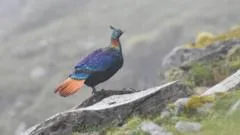
New research reveals how the iconic Himalayan monal is being forced to change both its voice and its habitat in response to human encroachment and climate change. As anthropogenic noise disrupts their natural communication, these birds are shifting their vocal frequencies to be heard over the din. This behavioral adaptation, coupled with shifting thermal niches, highlights a desperate struggle for survival. Such changes serve as a critical indicator of the broader ecological stress currently destabilizing high-altitude environments across the mountain range.
Why is the Himalayan monal changing its vocalizations?
The Himalayan monal is adjusting its pitch and call duration to ensure communication remains effective amidst rising anthropogenic noise. Researchers from Hemvati Nandan Bahuguna Garhwal University conducted a year-long study starting in April 2023, recording more than 700 monal calls to compare birds in different acoustic environments. The study focused on two distinct areas in the Kedarnath Musk Deer Sanctuary in Uttarakhand: the high-traffic tourist hub of Chopta, which experiences busy traffic and visitor footfall, and the relatively tranquil Madmaheshwar valley.
The findings revealed that monals living in noisy environments, such as Chopta, consistently produced calls with significantly higher peak frequencies than those in quieter habitats. Additionally, these birds utilized shorter call durations. This behavioral shift is likely a strategy to cut through the low-frequency noise generated by vehicle traffic and tourist footfall, which would otherwise mask their calls. Bird calls are among the most sophisticated forms of sound-based communication in the natural world, and these subtle changes, while potentially unnoticed by the human ear, could significantly interfere with essential biological functions.
A matter of behavioral flexibility rather than evolution
Dr. Rajeev Lochan, the lead researcher, clarified that these vocal shifts do not necessarily represent a permanent evolutionary change in the species' genetic makeup. Instead, the data suggests a high level of behavioral flexibility. The birds are actively adapting their communication styles to suit their immediate acoustic surroundings. This is a response to different acoustic environments rather than a fixed genetic shift.
However, while these adjustments allow for temporary survival in noisy valleys, they may still impact long-term reproductive success. If a species must constantly raise its pitch to be heard over tourist traffic, it may affect their ability to communicate effectively with potential mates or rivals. As Anjal Prakash, a public policy professor at FLAME University and contributor to IPCC reports, notes, when a species must change its voice to survive, it reveals how human pressure is rewriting the rules of life in the Himalaya.
How is climate change impacting the monal's habitat?
Climate change is projected to continue shrinking and destabilizing the suitable habitat for the Himalayan monal across the Indian Himalayas through the year 2100. The species relies heavily on alpine meadows located high in the mountains above the tree line, which serve as vital seasonal grazing grounds and biodiversity-rich habitats. According to the research, which utilized global climate models and emissions scenarios similar to those used by the Intergovernmental Panel on Climate Change (IPCC), the stability of these high-altitude zones is under severe threat.
As snow melts and vegetation patterns shift, the birds are being forced to move higher into the mountains to find suitable conditions. Dr. Lochan explains that these birds are slowly moving upwards as the snow melts and vegetation grows, making higher areas accessible. This upward migration is not solely driven by temperature changes; it is exacerbated by human encroachment in the lower alpine meadows, which are being crowded by human activity. The study models suggest that as the birds climb higher, they encounter a narrowing and increasingly unstable window of viable environment.
The risk of population fragmentation
The upward shift in altitude presents a significant biological risk: habitat fragmentation. As the available alpine meadows become smaller and more disconnected, monal populations may become trapped in isolated, fragmented pockets. The research indicates that the birds' seasonal migration may become increasingly difficult as climate changes force them into these smaller areas.
This lack of connectivity reduces the opportunities for breeding between different groups, which increases the risk of local extinction and long-term population decline. For a species with a narrow habitat range, such fragmentation can be catastrophic. The study warns that the population could become scattered in disconnected pockets, making the survival of the species increasingly precarious as they move toward higher, more limited elevations.
What makes the monal a key indicator for the Himalayas?
The Himalayan monal serves as a vital indicator of the overall health of the north-western Himalayan ecosystem due to its specific migratory patterns and narrow habitat range. The species moves seasonally between the lower montane zones—the ecological belts found on the lower slopes of the mountains—and high-elevation alpine zones. Because they traverse these distinct ecological layers, any disturbance in one zone is likely to manifest in the monal's behavior or population density.
Dr. Rajeev Lochan, who chose the monal for this study because of this specific movement pattern, noted that if the species is facing issues on this particular landscape, there is a strong possibility that ecological disturbances are affecting other birds as well. The monal essentially acts as a 'stand-in' for the broader environmental stresses affecting the region, signaling that the fragile Himalayan ecosystem may be pushed to a tipping point.
How are human activities driving these ecological shifts?
Rapid infrastructure expansion and unregulated tourism are the primary drivers of the environmental pressure currently facing the Himalayas. While the region has long been a destination for trekkers and researchers due to its scenic landscape, the last decade has seen a surge in accessibility. Rapid infrastructure development has made more places accessible, increasing footfall and disrupting wildlife.
Environmental practitioner Vishal Singh highlighted a fundamental disconnect in the region's current trajectory, stating that the economic development of the Himalayas is not currently aligned with its ecological integrity. The expansion of human settlements, transport networks, and urbanisation into previously remote areas is squeezing the natural habitats that species like the monal depend on. This mounting human pressure, coupled with climate change, suggests that the region's already vulnerable biodiversity is facing unprecedented stress.
The intersection of tourism and biodiversity
The tension between economic growth through tourism and the preservation of biodiversity is reaching a critical juncture. As more areas become accessible, the noise and physical presence of humans create a dual threat: they physically occupy the space needed by wildlife and acoustically pollute the environment required for natural communication. This intersection of factors suggests that without better-regulated development, the biological richness of the Himalayas may be permanently altered.
The research suggests that the monal is a victim of a broader trend where human-driven changes—both physical and acoustic—are forcing wildlife to adapt in ways that may not be sustainable. As the region continues to develop, the challenge remains to balance the economic benefits of tourism with the need to maintain the ecological integrity of these high-altitude environments.
Frequently asked questions
What is the significance of the Himalayan monal in the region?
The monal is a culturally significant bird, serving as the state bird of Uttarakhand in India and the national bird of Nepal. Beyond its cultural role, its seasonal movement between montane and alpine zones makes it a critical indicator of the health of the north-western Himalayan ecosystem.
Is the change in the monal's voice permanent?
No, current research suggests this is behavioral flexibility rather than a permanent evolutionary change. The birds are adjusting their pitch and call length in real-time to be heard over human-generated noise, such as traffic, rather than undergoing a genetic shift in vocal frequency.
Why are the birds moving to higher altitudes?
The birds are moving upward due to a combination of two factors: climate change, which is altering vegetation and melting snow, and human encroachment in the lower alpine meadows. This forced migration leads them into smaller, more fragmented habitats.
How does noise pollution affect bird communication?
Noise pollution, particularly low-frequency sounds from vehicles and tourist footfall, can mask the natural calls of birds. This interferes with essential behaviors, including territory defense and mating rituals. To compensate, birds like the monal must increase their pitch to ensure their messages are received.
What are the long-term risks for the monal population?
The primary long-term risks include population fragmentation and local extinction. As habitats become smaller and more disconnected due to climate change and human activity, the ability of different groups to breed with one another decreases, threatening the genetic viability of the species.
Key takeaways
- The Himalayan monal is altering its vocal pitch and call duration to communicate over human-induced noise.
- Climate change and habitat encroachment are forcing the species to migrate to higher, more fragmented altitudes.
- The monal serves as a key ecological indicator for the health of the north-western Himalayan ecosystem.
- Unregulated tourism and infrastructure development are creating significant pressure on mountain biodiversity.
Conclusion
The findings from the studies in Uttarakhand provide a stark warning about the changing reality of life in the Himalayas. The Himalayan monal, through its shifting voice and changing address, exemplifies the profound impact of human activity on specialized mountain species. As economic development continues to expand into these fragile zones, the pressure on biodiversity intensifies. Addressing these challenges requires a more integrated approach that aligns regional economic growth with ecological preservation, ensuring that the unique sounds and species of the Himalayas are not lost to the noise of progress.