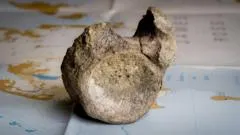
A dinosaur bone Antarctica discovery has emerged from decades of obscurity after a specimen was found lying in a storage drawer for 40 years. The fossil, originally unearthed in 1985 on James Ross Island, has been confirmed by experts as a tail vertebra belonging to a Titanosaur. This identification marks the first time a dinosaur bone has been formally recognised from the Antarctic continent. The specimen, held by the British Antarctic Survey, provides critical insights into the Late Cretaceous ecosystem. This article explores the history of the find, the anatomical features of the Titanosaur, and what this means for Antarctic paleontology.
How was a forgotten dinosaur bone Antarctica discovery made?
The identification of this prehistoric specimen began when Dr Mark Evans, the collections manager at the British Antarctic Survey (BAS), decided to inspect the contents of an unassuming storage drawer in Cambridge. The fossil had been part of the BAS geology collection for four decades without being definitively identified as dinosaurian in origin. Dr Evans noted that the process of reviewing thousands of specimens collected from various Antarctic expeditions often leads to unexpected breakthroughs when researchers scrutinise neglected items.
The fossil's history dates back to 9 December 1985, when it was collected on James Ross Island. At the time, the original discovery was documented in a field notebook by geologist Dr Mike Thomson. His notes described the object as a "vertebra of large reptile" and included a small, precise sketch. Because the specimen was approximately 10cm wide and lacked obvious dinosaurian characteristics to the initial team, it was likely categorised as a marine reptile and subsequently stored away.
The role of archival research in modern paleontology
Modern scientific breakthroughs are frequently driven by the re-examination of historical archives. In this case, the combination of Dr Evans' curiosity and the preservation of Dr Thomson's original field notes allowed the team to trace the specimen's provenance back to its exact collection date and location. This archival link is essential for validating the context of a find, especially when dealing with specimens that have been separated from their original geological strata for years.
What are the anatomical characteristics of the Titanosaur fossil?
The specimen is a tail vertebra that possesses a highly distinctive shape, allowing experts to identify it with certainty. Professor Paul Barrett from the Natural History Museum (NHM) was brought in to verify the find. He identified a specific combination of features, including a hollow on one end of the bone and a rounded bump on the other, which form a ball-and-socket joint structure typical of certain dinosaur groups.
According to Professor Barrett, these anatomical markers are a "dead cert" for identifying the specimen as a Titanosaur. The unique way these vertebrae line up to create a series of joints is a hallmark of this specific dinosaur lineage. While the fossil itself is relatively small, its morphology provides a clear window into the skeletal structure of these massive creatures.
How large was this specific Antarctic Titanosaur?
Scientists estimate that this particular individual was approximately 23ft (7m) in length, a significant departure from the massive scale typically associated with the Titanosaur group. While the largest known Titanosaurs could reach lengths of over 115ft (35m) and weigh roughly 60 tonnes, this specimen represents a much smaller version of the species.
The discrepancy in size has led researchers to propose two primary possibilities for the animal's biology:
- Juvenile Status: The specimen may have belonged to a young dinosaur that had not yet reached its full adult size.
- Species Variation: It could have been a smaller adult species that naturally bucked the trend of the larger, more famous Titanosaurs.
Regardless of its age, the bone provides a vital scale for understanding the diversity of dinosaur life that once inhabited the southern polar regions.
What was the environment of Antarctica 82 million years ago?
The Titanosaur lived during the Late Cretaceous Period, roughly 82 million years ago, a time when the Antarctic continent looked fundamentally different from the icy wasteland seen today. During this era, the region was characterized by a much warmer climate and was covered in lush, expansive forests.
This verdant landscape provided the necessary food sources for large, four-legged herbivores like the Titanosaur. These dinosaurs were plant-eaters, equipped with exceptionally long necks designed to reach vegetation in high canopies, and long tails used for balance. The presence of such a large herbivore indicates a highly productive and stable ecosystem capable of supporting massive biomass.
The impact of climate change on the fossil record
The transition from a forested, habitable continent to a frozen one has significantly complicated the study of Antarctic prehistoric life. The current ice sheets act as a massive barrier, concealing much of the geological and biological history beneath them. This makes the discovery of even a single bone a significant event for the scientific community.
Why is this discovery significant for Antarctic paleontology?
This discovery is transformative because it provides evidence of a "huge cast of characters" that once inhabited a region now considered largely uninhabitable. Although other dinosaur fossils have been found in Antarctica in the years following 1985, they remain relatively rare due to the extreme difficulty of conducting fieldwork in such a remote and harsh environment.
The identification of the Titanosaur helps scientists reconstruct the broader ecosystems at the bottom of the world. It proves that the Late Cretaceous Antarctic environment was a complex, thriving habitat. The findings, which have been published in the journal Acta Palaeontologica Polonica, serve as a reminder that the fossil record in Antarctica is still largely untapped and holds the potential to rewrite our understanding of prehistoric global biodiversity.
FAQ: Dinosaur bone Antarctica discovery
Is this the first dinosaur ever found in Antarctica?
This is the first dinosaur bone that has been formally confirmed and identified as such from the Antarctic continent. While other fossils have been found in the years since 1985, this specific specimen's identification as a Titanosaur marks a significant milestone in Antarctic paleontology.
What kind of dinosaur was the specimen?
The fossil is a tail vertebra belonging to a Titanosaur. Titanosaurs were a group of massive, four-legged herbivores known for their long necks and counter-balancing tails. They were among the largest dinosaurs to ever walk the Earth.
Where was the fossil originally discovered?
The specimen was originally unearthed on James Ross Island in 1985. It was subsequently stored in the geology collection of the British Antarctic Survey in Cambridge, where it remained unidentified for 40 years until its recent re-examination.
How large was the Antarctic Titanosaur?
Based on the size of the tail bone, scientists estimate this individual was about 23ft (7m) long. This is much smaller than the largest Titanosaurs, which could exceed 115ft (35m) in length and weigh up to 60 tonnes.
What was the climate of Antarctica during the Cretaceous period?
During the Late Cretaceous Period, approximately 82 million years ago, Antarctica was not covered in ice. Instead, it featured a much warmer climate with lush forests that provided ample food for large plant-eating dinosaurs like the Titanosaur.
Key takeaways
- A 40-year-old fossil from James Ross Island has been identified as the first confirmed Antarctic dinosaur bone.
- The specimen is a tail vertebra belonging to a Titanosaur, a group of massive plant-eating dinosaurs.
- The dinosaur was estimated to be approximately 23ft (7m) in length.
- The find confirms that Antarctica was a lush, habitable environment 82 million years ago.
Conclusion
The identification of the Titanosaur vertebra marks a pivotal moment in our understanding of Earth's prehistoric history. What began as a forgotten specimen in a Cambridge drawer has provided definitive proof of the biological richness that once existed in Antarctica. By bridging the gap between 1985 field observations and modern paleontological expertise, researchers have opened a new chapter in the study of the Late Cretaceous. As technology improves and exploration continues, this discovery suggests that the frozen continent may still hold many more secrets regarding the ancient ecosystems that once thrived at the bottom of the world.