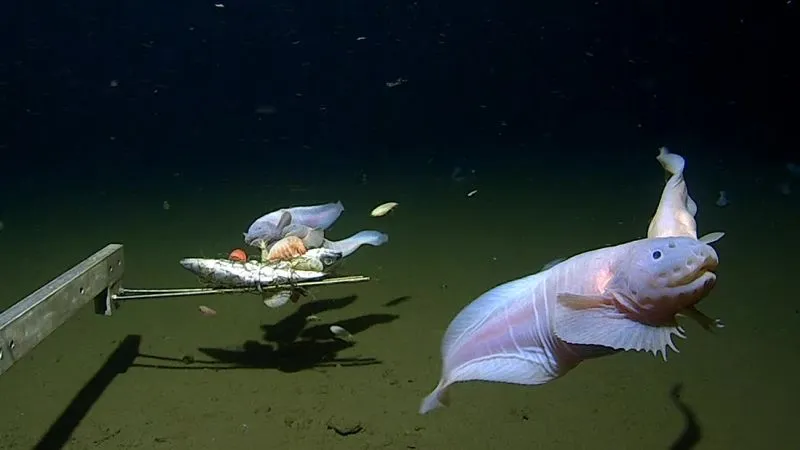
A major milestone in deep-sea biological research has been achieved with the recording of a snailfish at extreme depths, confirming that vertebrate life can thrive in the ocean's most hostile regions. This groundbreaking footage provides undeniable evidence of biological resilience within the hadal zone. By observing these creatures in their natural habitat, researchers can better understand how complex organisms adapt to crushing pressures and freezing temperatures. Furthermore, the expedition utilized advanced remote technology to capture these rare moments in the Japan Trench, marking a new era for marine science.
What is the significance of the deepest fish ever filmed?
The recording of a snailfish at extreme depths represents a major milestone in deep-sea biological research. For decades, scientists have sought to understand the limits of vertebrate life, specifically how organisms can withstand the immense hydrostatic pressure found in the deepest parts of the ocean. This sighting confirms that specialized species have successfully colonized the hadal zone, the region of the ocean below 6,000 metres.
The footage provides a rare visual confirmation of life in an environment previously thought to be too hostile for most complex organisms. By observing these creatures in their natural habitat, marine biologists can study movement, feeding patterns, and social interactions that are impossible to replicate in laboratory settings. This discovery pushes the known boundaries of where fish can survive on Earth, offering a glimpse into the resilience of life under conditions that would be lethal to almost any other vertebrate. The presence of such life suggests that the biological complexity of the deep ocean is far greater than previously theorized.
How was the snailfish captured in the Japan Trench?
Advanced deep-sea camera technology enabled researchers to film the snailfish in the dark, high-pressure environment of the Japan Trench. Using remotely operated vehicles (ROVs) or similar deep-sea deployment systems, scientists were able to navigate the rugged terrain of the seabed to locate these elusive creatures. The Japan Trench, located in the western Pacific Ocean, provides a unique setting for such exploration due to its extreme depths and complex topography.
Capturing clear imagery at such depths requires specialized lighting and pressure-resistant housings. The technical challenge of operating in the hadal zone cannot be overstated, as the equipment must function perfectly under pressures that would crush standard maritime tools. The successful mission highlights the growing capabilities of modern oceanographic engineering and the ability of researchers to penetrate the most remote and inaccessible parts of the ocean floor. Without these specific technological advancements, the snailfish would have remained a theoretical inhabitant of the trench rather than a filmed reality.
Technological requirements for hadal exploration
To reach the depths where these fish reside, exploration vessels must deploy highly specialized equipment. This includes high-definition cameras capable of operating in near-total darkness and sensors that can withstand several hundred atmospheres of pressure. The precision required to maneuver these tools around the seabed without disturbing the fragile ecosystem is a testament to recent advancements in robotics and marine technology.
Beyond mere visibility, the engineering must account for the extreme cold and the corrosive nature of the deep-sea environment. Every component of a deep-sea deployment system, from the tethering to the battery life of the ROV, must be optimized for long-duration missions in high-pressure zones. This technological leap is what allows scientists to move from theoretical models of the deep sea to actual, visual observation of its inhabitants. The ability to maintain structural integrity while transmitting data from such depths remains one of the most significant hurdles in modern marine science.
What are the biological characteristics of the snailfish?
Snailfish are uniquely adapted to survive the extreme conditions of the deep ocean. Unlike many other fish species, they often possess translucent skin and lack the heavy scales found in shallower-water relatives. These physiological traits are thought to help them manage the intense pressure and low temperatures of the deep sea. Their bodies are often soft and gelatinous, a structural adaptation that allows them to remain buoyant and functional under crushing weight.
Furthermore, their metabolic processes are highly specialized to thrive in an environment where food sources are scarce and unpredictable. Because energy is a premium in the hadal zone, every aspect of their biology is geared toward efficiency. Studying these adaptations helps scientists understand the broader evolutionary paths taken by life in extreme environments and how proteins and cellular structures can be modified to resist being crushed by hydrostatic pressure. This biological resilience provides a blueprint for understanding how life might exist in other extreme environments across the globe.
What does this discovery mean for future ocean research?
This sighting opens new avenues for studying the biodiversity of the world's deepest trenches. As technology continues to improve, scientists expect to find even more specialized species that have remained hidden for centuries. The discovery suggests that the hadal zone is far more biologically active than previously estimated, serving as a complex ecosystem rather than a barren void.
Future research will likely focus on the genetic makeup of these deep-sea residents to determine how they evolved such unique survival mechanisms. Additionally, understanding these ecosystems is vital for assessing the impact of human activities, such as deep-sea mining or climate change, on the most remote parts of our planet. The deep ocean remains one of the final frontiers of biological discovery, and each new sighting provides a piece of the puzzle regarding the global marine food web. As we deepen our understanding of these trenches, we gain a clearer picture of the interconnectedness of all oceanic life.
FAQ: Deepest fish ever filmed
Where was the deepest fish filmed?
The deepest fish was filmed in the Japan Trench, an oceanic trench located in the western Pacific Ocean. This area is known for its extreme depths and serves as a primary site for studying hadal zone biology and deep-sea ecosystems.
What kind of fish was recorded?
The fish recorded was a species of snailfish. Snailfish are known for their ability to inhabit extremely deep waters, possessing unique physiological adaptations that allow them to survive the intense pressure and cold temperatures of the deep ocean.
Why is filming at such depths difficult?
Filming at these depths is difficult because of the extreme hydrostatic pressure and the total absence of sunlight. Equipment must be specifically engineered to withstand immense crushing forces and must include powerful, specialized lighting to capture any visible imagery of the seabed.
Can other animals live in the hadal zone?
Yes, the hadal zone is home to various specialized organisms beyond fish, including amphipods, sea cucumbers, and various microbes. These creatures have all evolved specific biological traits to survive the high-pressure, low-temperature, and food-scarce conditions of the deepest ocean trenches.
How does this discovery help science?
This discovery helps science by providing direct visual evidence of life in extreme environments. It allows biologists to study the behavior and physical characteristics of hadal species, which informs our understanding of evolutionary biology and the limits of life on Earth.
Key takeaways
- A snailfish was filmed at extreme depths in the Japan Trench.
- The discovery confirms vertebrate life can thrive in the hadal zone.
- Specialized deep-sea technology was required to capture the footage.
- Snailfish possess unique adaptations like gelatinous bodies to survive pressure.
- This finding expands our understanding of deep-sea biodiversity.
Conclusion
The filming of the deepest fish ever recorded in the Japan Trench marks a significant achievement for marine biology and deep-sea exploration. By capturing these elusive snailfish on camera, scientists have gained a rare window into one of the most extreme environments on the planet. This discovery not only highlights the incredible resilience of life but also underscores the necessity of continued technological investment in oceanography. As we continue to explore the hadal zone, we move closer to understanding the full complexity of Earth's biological limits and the mysteries of the deep ocean.