New intelligence reports have surfaced providing a much deeper look into the technical sophistication of the Chinese spy balloon that recently transited North American airspace. These findings reveal the true extent of the craft's surveillance capabilities, specifically highlighting its ability to perform real-time data transmission back to mainland China. Furthermore, the intelligence suggests that this incident is not an isolated event, but rather part of a much larger, suspected global fleet of high-altitude surveillance platforms designed for persistent monitoring and strategic intelligence gathering.
What were the technical capabilities of the Chinese spy balloon?
The Chinese spy balloon was equipped to perform sophisticated electronic and visual surveillance while in transit. According to sources familiar with the matter, the craft was able to capture imagery and collect signals intelligence from various US military locations. Crucially, the device possessed the ability to transmit this collected data back to Beijing in real time, allowing for immediate intelligence processing.
Despite these capabilities, the US intelligence community has maintained a measured stance regarding the severity of the breach. Officials noted that the information gathered by the balloon is not significantly more advanced than the data that Chinese satellites can already collect while orbiting similar locations. Gen. Glen VanHerck, the commander of US Northern Command and NORAD, stated at the time that the US "did not assess" that the balloon "presented a significant collection hazard beyond what already exists in actionable technical means from the Chinese." This suggests that while the balloon provided a different perspective, it did not represent a fundamental shift in the technical intelligence gap between the two nations.
Data security and transmission concerns
A primary concern for US intelligence officials involves the integrity and destination of the transmitted data. While it is confirmed that the balloon could send information back to China, the US government remains uncertain whether the Chinese government has the capability to remotely wipe the balloon’s data as it is received. This uncertainty creates a strategic dilemma: if the data is being processed and stored in real time, the US may be unaware of exactly what intelligence has been successfully exfiltrated.
A senior State Department official noted in February that as the balloon floated across the US, it was capable of conducting signals intelligence collection operations. The possibility that China could manage the data remotely adds a layer of complexity to the assessment of what was actually lost during the flight. The US government continues to grapple with whether there is intelligence the balloon was able to gather that the US still doesn't know about.
How did the balloon impact US national security?
The flight of the balloon over the continental United States triggered significant security protocols and highlighted vulnerabilities in airspace monitoring. The balloon first entered US airspace over Alaska in late January, eventually moving through Canada and into Montana. During its time over Montana, the craft hovered for several days, leading US officials to conclude that it was attempting to surveil sensitive military installations, such as Malmstrom Air Force Base.
To mitigate the impact, the US government utilized several defensive strategies. Officials stated that the US was aware of the balloon's projected path, which allowed them to protect sensitive sites. Furthermore, the US was able to censor certain signals before the balloon could intercept them, effectively limiting the amount of actionable intelligence the craft could collect. Despite these efforts, the incident caused a notable diplomatic rift, contributing to the postponement of a planned visit to China by US Secretary of State Antony Blinken.
What is the scale of the Chinese surveillance balloon fleet?
The incident involving a single balloon is part of a much larger, coordinated surveillance program managed by the Chinese military. According to the US intelligence community, a method has been developed to track a fleet of these balloons operating on a global scale. While the exact number of vessels in the fleet is unknown, sources indicate that the program has conducted at least two dozen missions across at least five continents in recent years.
The scale of this operation suggests a systematic approach to global intelligence gathering. While roughly half a dozen of these flights have occurred within or near US airspace, the program is not limited to the North American theater. Much of this surveillance activity is reportedly managed out of the Chinese province of Hainan. The variety of locations targeted suggests that China is utilizing these high-altitude platforms to supplement their existing satellite capabilities with persistent, low-orbit surveillance.
The role of Hainan in surveillance operations
The identification of Hainan as a hub for these operations provides a geographical focal point for understanding how China manages its high-altitude assets. By operating out of a specific province, the Chinese military can centralize the command and control of these balloons, allowing for the coordinated execution of the dozens of missions reported by intelligence officials. This centralization facilitates the global reach of the fleet, enabling it to operate across multiple continents simultaneously.
While China has maintained that the balloon was actually just a weather balloon thrown off course, US officials believe the program is a deliberate military endeavor. The ability to coordinate missions across five continents from a centralized location like Hainan points to a highly organized and well-resourced surveillance infrastructure.
What has the FBI discovered during the investigation?
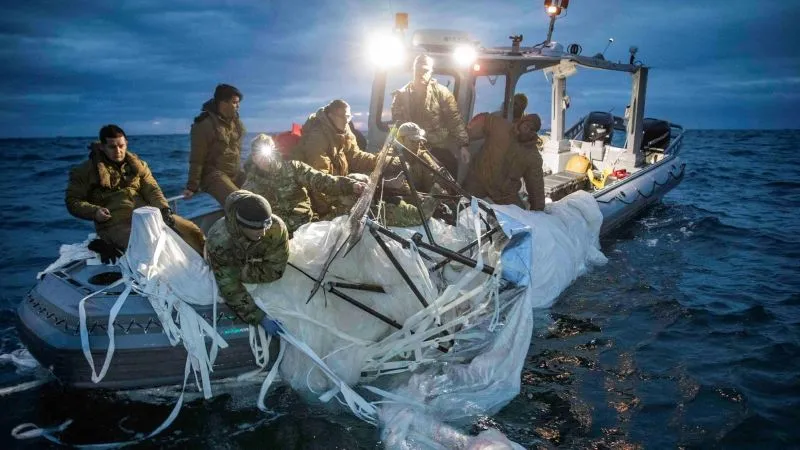
The FBI is currently conducting a detailed forensic examination of the wreckage recovered from the waters off Myrtle Beach, South Carolina, on February 5, 2023. This investigation aims to uncover the specific engineering and software architecture that allowed the balloon to function. So far, officials have been able to extract technical details regarding the balloon's design, its power sources, and the specific algorithms used in its flight software.
Analyzing the software and algorithms is a critical component of the investigation. By understanding how the balloon's software operates, US intelligence can better predict the behavior of future balloons and develop more effective countermeasures. This technical intelligence is vital for identifying the specific capabilities of the Chinese military's high-altitude platforms and for refining the methods used to track and intercept them in the future. The investigation into how the device is powered and designed continues to provide insights into the technical sophistication of the Chinese military's capabilities.
FAQ: Chinese spy balloon intelligence
What kind of intelligence did the balloon collect?
The balloon was capable of collecting both imagery and signals intelligence. This means it could take high-resolution photographs of military sites and intercept electronic communications or other radio frequency signals. This allowed it to monitor sensitive locations and potentially capture data regarding US military movements and communications.
Was the intelligence gathered considered critical by the US?
No, the US intelligence community has stated that the flight does not appear to have provided critical new insights to China. A US intelligence official noted that while analysis of the wreckage remains ongoing, the flight did not appear to provide critical new insights to the People's Republic of China. Officials noted that the information gathered was not significantly more sophisticated than what is already obtainable through Chinese satellite surveillance.
How many Chinese surveillance balloons are in operation?
The exact size of the fleet is unknown, but intelligence sources suggest the program has conducted at least two dozen missions across five continents. While the total number is not confirmed, the frequency and global reach of these missions indicate a large-scale, military-controlled surveillance operation.
What was the US response to the balloon's flight?
The US responded by tracking the balloon's path, protecting sensitive military sites, and censoring certain signals to prevent interception. Ultimately, the US shot down the balloon off the coast of South Carolina on February 4, 2023, following its transit through several US states.
Did China admit the balloon was for spying?
No, China has maintained that the balloon was a weather balloon that was blown off course. However, US officials believe the balloon had the ability to maneuver and was used deliberately to loiter over sensitive military installations to collect intelligence.
Key takeaways
- The balloon could transmit captured imagery and signals intelligence to Beijing in real time.
- US intelligence suggests the data gathered was not significantly more advanced than satellite imagery.
- The Chinese surveillance program has conducted at least 24 missions across five continents.
- The FBI is analyzing the balloon's software algorithms and power design from the recovered wreckage.
Conclusion
The Chinese spy balloon incident represents a significant escalation in the technological and diplomatic tensions between the United States and China. While US officials have mitigated much of the immediate intelligence loss through signal censorship and site protection, the ability of the craft to transmit data in real time highlights a persistent surveillance threat. The discovery of a wider, global fleet of such balloons suggests that high-altitude surveillance is a core component of China's long-term intelligence strategy. As the FBI continues to dissect the technical wreckage, the focus shifts toward developing more robust defenses against this evolving form of aerial espionage.